
#09 - Public Goods
What can the French Revolution teach us about how to create mutual benefits?
In his book Misbehaving (2015), behavioural economist Richard Thaler describes a simple experiment known as the ‘Public Goods Game’.
We invite ten strangers to the lab and give them each $5. Each person then decides how much money they want to contribute to the ‘public good’ by placing that money in a blank envelope anonymously. The total contributions to the public good are doubled, and that amount is divided equally among all the players.
The ‘rational’, selfish strategy in this scenario is to contribute nothing: for every dollar you donate, it is doubled ($2), then divided by 10, meaning you get back 20 cents. If everyone follows this logic, they all go home with $5. However, if everyone puts in all their money, they each go home with $10.1 Most times the experiment has been run, people generally end up contributing around half their stake to the public good. (Economics graduates, tellingly, only contributed 20%.)
There are thousands of public goods games that play out in society every day. Take the roads, for instance: driving around like you’re in Grand Theft Auto would almost certainly make your individual journey quicker, yet if everyone behaved like that, the average journey would likely be slower (and certainly more dangerous) overall.
Yet in society, unlike in the lab, the parameters of these systems are constantly shifting and not always discernible: how much we are asked to put in may change; benefits may not be evenly distributed, or distributed at such a far remove that they are difficult to connect with our contributions; or we may simply not trust the rules of the game. How we think about ourselves, our fellow citizens, and the structures that connect us will substantially influence our behaviour.
Politics can in some ways be described as a system for establishing and mediating the rules of public goods games. Debates about who should pay what taxes, whether young people should perform national service, and how our voting system should work are all debates about who should contribute what and how the benefits should be distributed. People’s willingness to contribute poses major challenges for any policy-maker: some groups (such as nimbys) object to what they perceive as a disproportionate impact; others lobby for carve-outs (such as tax exemptions on private equity carried interest) on the basis that they make a special contribution to the economy; and a few may simply choose to quit the political community altogether, jetting off to Dubai to pay no income tax and take pictures in front of their gold-plated Mercedes (because ‘London just isn’t safe anymore’, you know).
Most special interests serve purposes, at least to begin with. Think, for example, of how South Korea built up its economy by empowering the chaebols (industrial conglomerates ruled by a single family). Over time, however, these interests can accumulate and ossify, limiting our ability to create public goods. A crucial question is therefore: how can these interests be dislodged?
Consider (as you do) the French Revolution.
Medieval European society was made up of a patchwork of special rights, exemptions and obligations, known collectively as ‘privileges’ (from the Latin privus, meaning private, and lex, meaning law). Groups of manufacturers or merchants, known as ‘guilds’, were granted exclusive rights to make or sell certain goods; nobles or clergymen might have the right to be tried in their own courts; and whole provinces were exempted from certain taxes. For this reason, Freemen of the City of London still enjoy the ‘privilege’ of being able to drive their sheep across London Bridge.
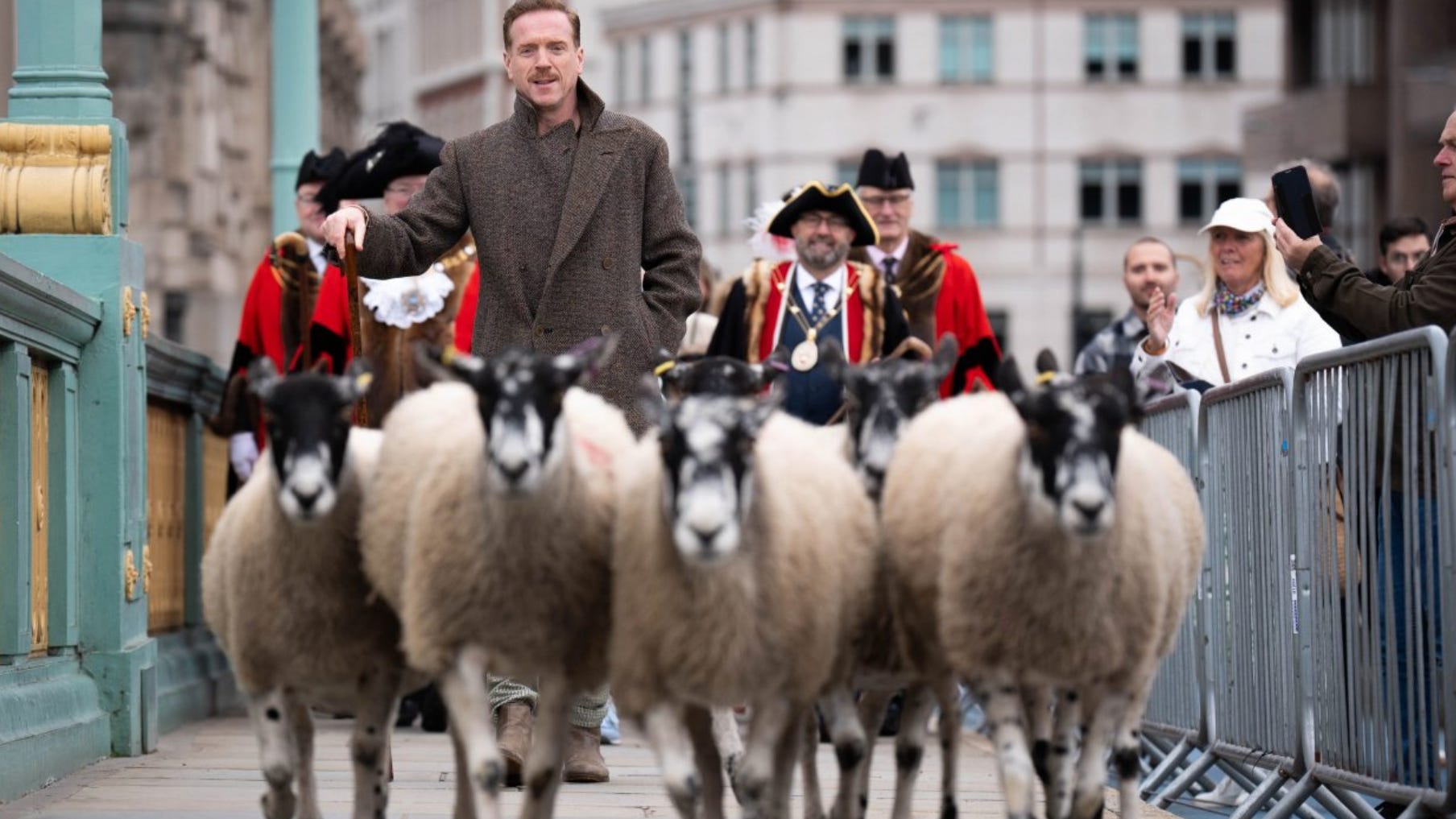
Damian Lewis, for some reason, exercises his privilege to drive sheep over London Bridge.
The medieval system of privileges reflects a very different way of conceptualising the difference between ‘public’ and ‘private’ interests. For a start, privileges tended to be conveyed on people on account of being members of a certain group (fishmongers, for instance) rather than as individuals in themselves. These were not understood as ‘rights’ in the modern sense – inalienable freedoms due to every human being – but as something that reflected the group’s special contribution to the social order and the ‘common weal’. In many cases, privileges came with active duties or obligations, such as taking on a particular role in court or civic ceremony, reflecting this two-way relationship between the private group and the public whole.
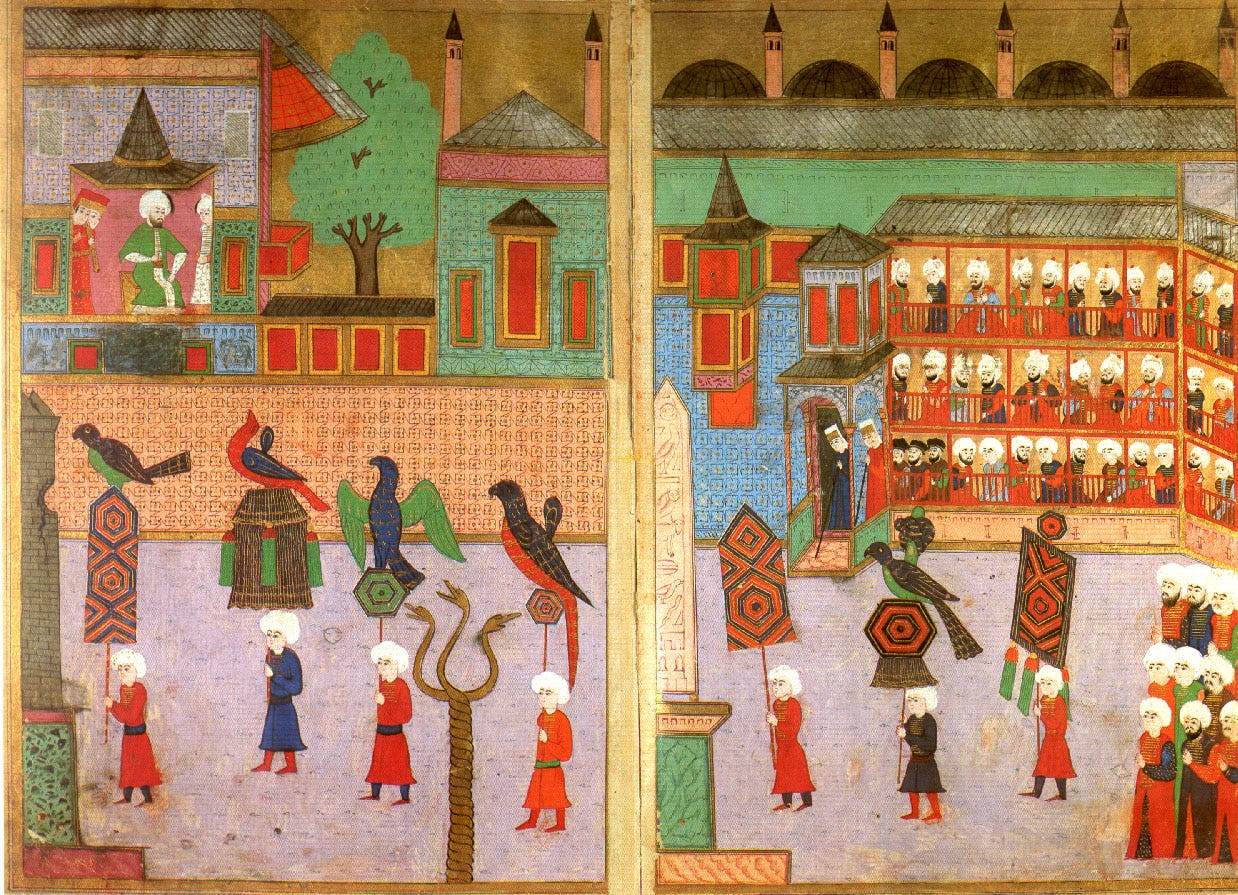
The cloth-weavers of Istanbul parade before Sultan Süleyman in a processing to commemorate the marriage of his daughter Hatice to Grand Vizier Ibrahim Pasha (1524).

Over time, however, new ideas began to erode this conception of public and private, and criticisms of ‘privilege’ began to mount. Nowhere was this truer than in France, where by the eighteenth century the vast array of exemptions granted to regions and social groups had made the country significantly harder to govern. Proponents of the doctrine of universal and inalienable ‘rights of man’ – the idea that certain ‘natural rights’ are owed to everyone and cannot legitimately be deprived by the sovereign – argued, as Diderot did in his famous Encyclopédie (1751-72), that ‘the only legitimate privileges are those given by nature itself’.
This universalism reached its apotheosis in the French Revolution of 1789. On 4th August, the National Constituent Assembly (a successor to the Estates General) met to discuss the disorder that was sweeping the country after the Fall of the Bastille. In what commentators would nowadays no doubt describe as ‘a feverish all-night session’, nobles, clergy and provincial representatives voluntarily came forward to abdicate the privileges they had accumulated over centuries. Out went private courts, tolls, hunting rights, tithes, tax exemptions, the sale of office and serfdom – effectively abolishing the feudal system overnight.
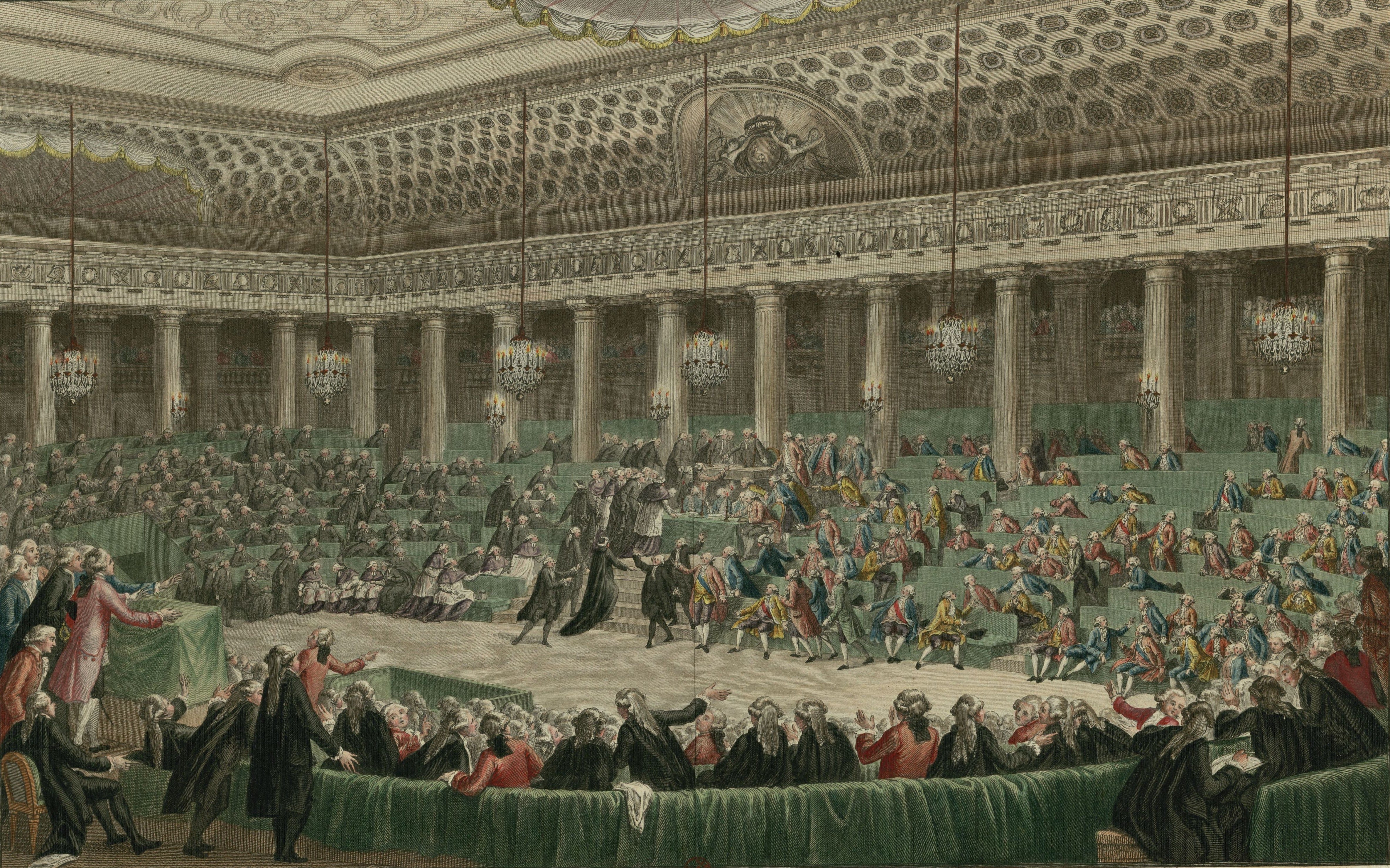
Charles Monnet’s depiction of the night of 4th August 1789.
.jpg)
What moved the Assembly to this apparent orgy of self-abnegation? To begin with, there was an immediate need to put an end to the unrest enveloping France, which had in many cases already de facto ended feudalism. Yet delegates were also clearly moved by the ideology of universalism, believing, as Emmanuel Joseph Sieyès did, that by removing these privileges ‘the nation would not be something less but something more’. Together, these factors coalesced into the social condition we might describe as a ‘movement’, with each contribution bringing forward further contributions on the basis that all orders of society were putting in and the distribution of benefits would be ‘fair’.
The night of 4th August 1789 was clearly exceptional. Nonetheless, these three conditions – material, ideological and social – have been critical to the creation of many public goods, from women’s suffrage (direct action, equality, women’s contribution during World War One) to Roosevelt’s New Deal (the depression, Keynesianism, the mutualism inherent in the social safety net).
Recreating these conditions today is not without its challenges. Ideologically, although the doctrine of universal ‘rights of man’ is very much still with us, over time it has become significantly more individualised, morphing into the idea of ‘human rights’ – freedoms owed as an overriding priority to each individual simply by virtue of being human. In developed societies, the idea of human rights has proved an exceptionally effective way of guarding individuals from harm and enlarging freedoms to previously discriminated-against groups. What it lacks, however, is a clear conception of how those individuals group together to form societies.
This has resulted in some extreme formulations on both left and right. On the left, we have seen the rise – peaking in the late 2010s – of a discourse around ‘trigger warnings’ and ‘safe spaces’, which often places the psychological safety of the individual above wider social factors. Much media debate has focused on whether this psychological safety is desirable, but the more critical point is whether it constitutes a fundamental and inalienable right, rather than something that we should aim to encourage through healthy social norms. And on the right, the kind of socially-grounded liberalism found in the writings of Smith and Locke has in some quarters been replaced by the highly asocial liberalism promoted by Reagan and Thatcher.
What do I mean by this last point? Thatcher’s remark that ‘there is no such thing’ as society is often misquoted: what she meant is that society is not a ‘thing in itself’, but rather the sum of ‘a living structure of individuals, families… and voluntary associations’. Thatcherite hyper-liberal economics holds that each of these individuals is a rational economic agent in their own right, and that each of these agents pursuing their self-interest in a largely uninhibited way leads ultimately to the best interests of all. This is a historically unprecedented idea – radically different even from Victorian liberalism, with its pseudo-Classical emphasis on charity (i.e., the selfless abandonment of self-interest) – which effectively disowns the idea that there is any such thing as a ‘public goods game’ at all: self and mutual interest are never opposed!2
In recent years, the limitations of these ideas have become increasingly clear to thinkers on both left and right – perhaps in part because the malaise frustrated voters in the former industrial heartlands of northern England, the Rust Belt, Hauts-de-France and the former East Germany are facing is primarily social, not rights-based or economic. (In addition, because as Farage and Le Pen have wisely noticed, Thatcherite economics leaves little room for nation or culture.) To maximise contributions to the public good, a new ideology is therefore needed, one that frames state and society – including the very act of politics itself – as something that is the mutual contribution of individuals in the way that the New Deal was, and consequently not only something from which we are owed rights but something to which we owe contributions.
In itself, however, the circumstances of the French Revolution suggest this ideology will be ineffectual unless sustained by a broader sense of movement. As Left on Read has previously explored, building this movement begins with taking a more open, honest and human approach to political communications. Politicians must also pursue policies that aim to rebuild a sense of fairness, for instance by restructuring the political system to reduce the impression of vested interests (significantly tightening lobbying laws and flattening abnormalities in the tax system) and creating clear ‘you lose, we win’ trade-offs (i.e., where one group’s contribution leads immediately and tangible to a mutual benefit, such as by flattening out Council Tax, or tying reduced energy bills to an increase in the top rate of income tax).
As Thatcher correctly identified, we have become overwhelmingly dependent on the state to deliver public goods. Yet this dependence is only a problem insofar as our relationship with the state is largely impersonal and asocial – i.e., something that exists outside of society rather than as part of and within it. We therefore need to set about integrating the state much more closely into communities, while at the same time deploying its resources to actively build up the fabric of society – rather than seeing the state as something that simply ‘happens alongside’ social change.
As any left-winger must admit, nationalism has proved by far and away the most effective way of tying state to society and encouraging mutual contribution over the past two centuries. The best (and perhaps only) alternative is localism. Politically, this should begin with ‘hyper-devolution’ (giving communities direct control over some neighbourhood funding) and direct democracy (requiring Councils to, for instance, establish citizens’ assemblies). At the same time, we should take lessons from local government’s increasing experience cooperating with community networks (volunteer organisations, sports teams) and seek to give people a financial stake in government through community interest funds (e.g., for energy projects) and municipal bonds (often used for climate initiatives, but applicable to any public infrastructure).
With widespread dissatisfaction with the state of society, and both left and right showing an increased interest in social and cultural readings of politics, there is reason to believe that our three conditions for the creation of public goods – material, ideological, social – may soon be met. As the course of the French Revolution shows, such moments carry significant risk: communitarianism can slip easily into totalitarianism and mutual interest into suspicion. The left should act fast to disseminate its own vision of the public good, one not defined by exclusion, but rooted in fairer economic relationships and distributed political decision-making.
Yours, checking what’s inside the envelope,
Left on Read
P.S. ‘Community’ has become a real buzzword, so having used it nearly ten times in this essay I feel a bit unwell. Any alternatives are gratefully received.
The best outcome for an individual is of course to contribute nothing but hope that everyone else puts all their money in, in which case you will go home with $14 (your own $5 plus a 10% share of the doubled $45).
Although written well before Thatcher, I highly recommend Karl Polanyi’s The Great Transformation (1944), which traces the origins of this asocial model of liberalism.