
#12 - Leader Profiles: Pedro Sánchez
What Spain's combative left-wing PM can teach us about how to thrive in chaos
For this issue, Left on Read is trying something new: an in-depth examination of the tactics used by a particular politician. If you’d like to see more similar profiles in future, let me know in the comments or by message.
Pedro Sánchez, Spain’s combative left-wing PM since 2018, has been in the headlines recently.
First, there’s the unexpectedly excellent performance of the Spanish economy. After taking a battering during the Eurozone crisis, when unemployment topped 25%, and then suffering the effects of Covid, Spain’s economy has recently roared back. In 2024, GDP grew by a mighty 3.5% – accounting for 40% of the Eurozone’s total growth that year – followed by 2.8% in 2025, easily the best performance of any major European economy. Analysts have variously attributed this success to a tourist boom, immigration, growth in high-value services, clean energy investments and EU post-pandemic recovery funds.
Then there are Sánchez’s high-profile interventions on international affairs. A longstanding and vocal critic of Israel, Sánchez’s government in 2024 recognised a Palestinian state and then leant its support to the genocide case brought by South Africa at the International Court of Justice. Following the recent US-Israeli attacks on Iran, Sánchez denounced the “unjustified, dangerous military intervention” and refused to allow the US to use Spanish military bases as part of their operations, leading Trump to threaten to “cut off all trade” with Spain. Sánchez’s open resistance to Trump, in stark contrast to the ‘softly, softly’ approach pursued by most European leaders, has further distanced him from the European mainstream, but made him something of a darling on the left.
For this issue, Left on Read is less concerned with Sánchez’s policies and more with his political tactics. As the most high-profile leader on Europe’s left, how has Sánchez stayed in power for eight unsettled years, and managed to leave his imprint on Spain in the process? And what could other left-wing leaders learn from his pragmatic, controversial, and ideological style?
Sánchez’s rise has coincided with a highly unsettled time in Spanish politics.
His party, the Partido Socialista Obrero Español (Spanish Socialist Workers’ Party, or PSOE), is the major party on Spain’s centre-left, broadly equivalent to the Parti socialiste in France, the SPD in Germany, or Labour in the UK. Regularly in power since Spain transitioned to democracy in the 1970s, the PSOE had the misfortune of being in government during the 2008 crash. At the election in 2011, their centre-right rival the Partido Popular (People’s Party, or PP) won a landslide, promising to impose austerity measures. Consequently, when Sánchez became PSOE leader in 2014, his party was deeply unpopular, and could only manage a tame 22% of the vote in his first election as leader in 2015.
After both the 2015 and 2016 elections failed to produce a parliamentary majority for any party, there was much debate in the PSOE about whether to enable the PP to form another government, which would inevitably pursue further austerity, by abstaining from voting against them. In the following political crisis, Sánchez demonstrated his trademark mix of opportunism and pragmatism: having previously said that the largest party should be given the chance to form a government, he instead blocked the PP, leading rivals from within the PSOE to depose him as leader. In the resulting leadership election, however, Sánchez’s hardline stance endeared him to the party members, and he was re-elected leader in 2017.
Up to this point, Sánchez was something of a liberal technocrat, not dissimilar to Mario Draghi or Macron. Sometimes nicknamed ‘El Guapo’ (‘the handsome one’) for his tall height (6’3”) and striking jawline, he is a clear speaker, with an excellent grasp of English, but not a populist in tone. Yet his ousting at the hands of party officials enabled him to position himself as an outsider, an image he embraced as he toured Spain in his Peugeot, campaigning on an anti-establishment message to win the leadership back. This episode reveals something else about Sánchez’s political inclinations: while always deeply pragmatic, his response to crisis has consistently been to become more ideological, not less.

Pedro Sánchez and his ally Adriana Lastra tour Spain in his Peugeot in 2017.
Back as party leader, Sánchez had to contend with the rapidly shifting dynamics of Spanish politics. The 2010s in Spain saw the rise of several new political parties, principally Ciudadanos (‘Citizens’), a populist party of the centre, Podemos (‘We Can’), a far-left anti-austerity party, and Vox, on the far-right, as well as a host of increasingly popular Catalan separatist groups.
These parties have transformed the nature of Spanish democracy. Although Spain has a system of proportional representation, it is based on fifty constituencies and uses a method of proportioning (the ‘D’Hondt method’) that slightly favours larger parties. Thus, until the 2010s, parliamentary majorities were common in Spain, and formal coalitions unheard of. Yet since 2015, no single party has recorded more than 33% of the vote or obtained an outright majority, leading to hung parliaments, coalitions and confidence and supply arrangements galore.
In these circumstances, Sánchez’s combination of a pragmatic approach to government formation and his increasing drift towards the left have proved good bets. In 2018, Sánchez became PM via a successful vote of no confidence against the PP, during which he promised Basque separatists that he would uphold the most recent PP budget. As a result, his government was quickly brought down by Podemos, but after two quick-fire elections in 2019, he made a pact with the left-wing populists, giving Spain its first coalition government since the return to democracy. Later in 2023, he struck perhaps his most controversial deal yet, offering to pardon those involved in Catalonia’s unsanctioned independence referendum of 2017 in return for the support of Catalan separatist parties.
The resulting howls of outrage from those on Spain’s right were expected. Yet Sánchez has never feared political confrontation: often he encourages it as a means of splitting the opposition, making alliances, and strengthening his base. In the very same month he first became PM in 2018, Sánchez announced an exceptionally controversial plan to exhume the remains of former dictator Francisco Franco from their resting place in an elaborate mausoleum in Spain’s ‘Valley of the Fallen’ near Madrid – cue an enflaming of the already fiery debate over Franco’s place in Spain’s recent history.
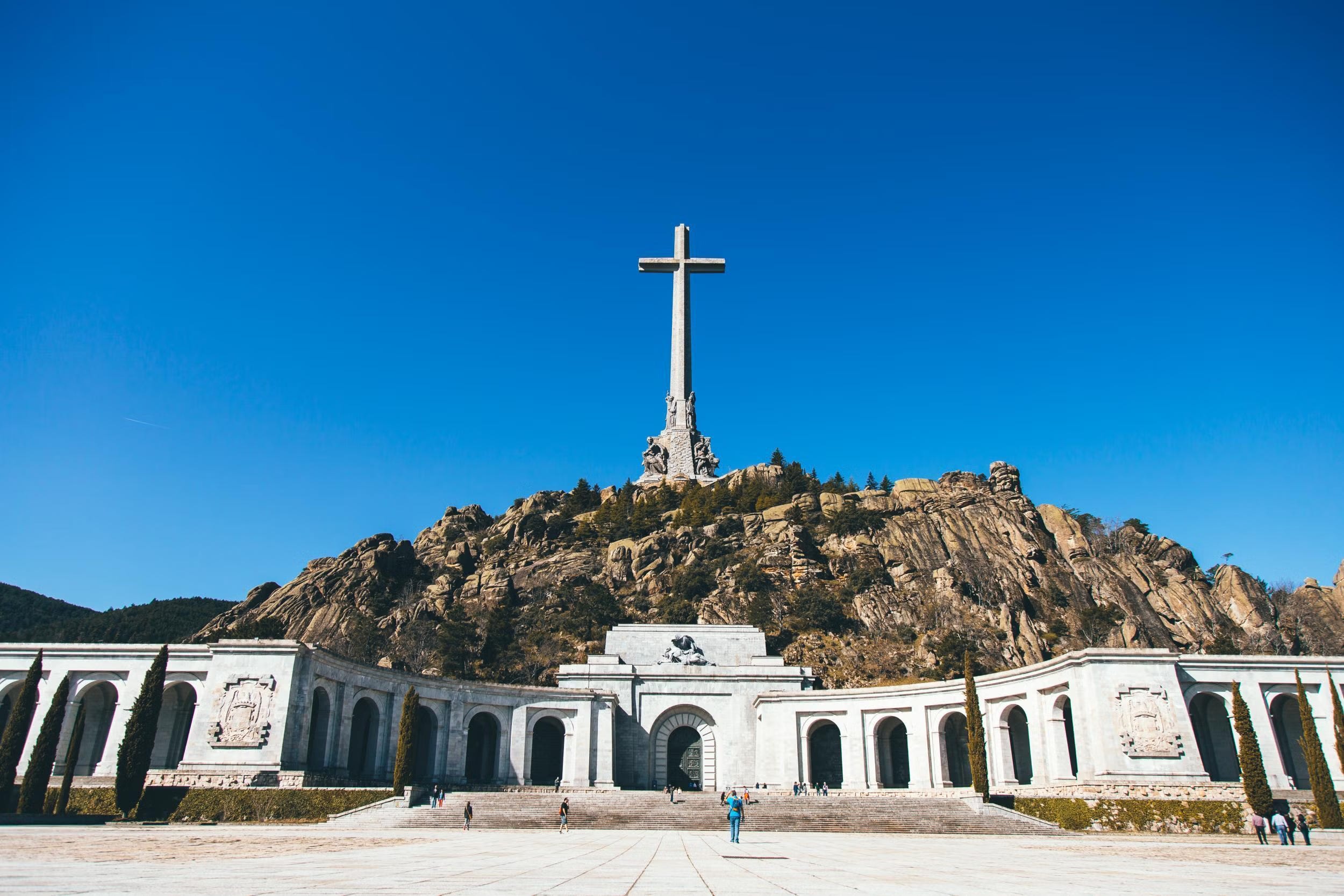
The ‘Valley of the Fallen’, where Franco’s remains were interred until 2019.
Since Covid, Sánchez has continued to move further left, with other controversial proposals including a recent plan to legalise the status of around 500,000 undocumented migrants, and making Spain one of very few European nations to increase, not cut, foreign aid. All this has taken place against the background of rising support for the far-right, which most liberal politicians in Europe have attempted to counteract by making concessions, for instance on immigration.1 As journalist Dave Keating puts it: “While other European leaders zig, Pedro Sánchez zags.”
As opposition leader and later PM, Sánchez has had to contend with the Eurozone crisis and its aftermath, the migrant crisis, an attempted Catalan secession, Covid, Russia’s invasion of Ukraine, Trump 2.0 and much more. At the same time, Spanish politics has gone through an unprecedented era of fragmentation, with traditional mainstream parties struggling and new populist ones rising up, while Spanish society has been riven with culture wars on issues from racism and sexism in football to Spanish unity and Spain’s relationship with its Francoist past.
Polycrisis, political fragmentation and social division: sound familiar to anyone? A big part of your perception of Sánchez may depend on whether you see him as contributing towards, or merely navigating, this chaos. Either way, the methods he has used to succeed during this tempestuous period should be required learning for other European politicians today.
One of the most intriguing aspects of Sánchez’s success is the fact that he has remained PM since 2018 despite never winning more than 32% of the vote. And, like most contemporary politicians, he has never been universally popular: Currently, his net approval rating (the percentage of respondents that have a favourable opinion of him minus those with a negative opinion) is -31 – worse than Meloni, though significantly better than Merz, Macron and Starmer. A considerable majority of the Spanish electorate think he is doing a bad job and have no intention of voting for him.
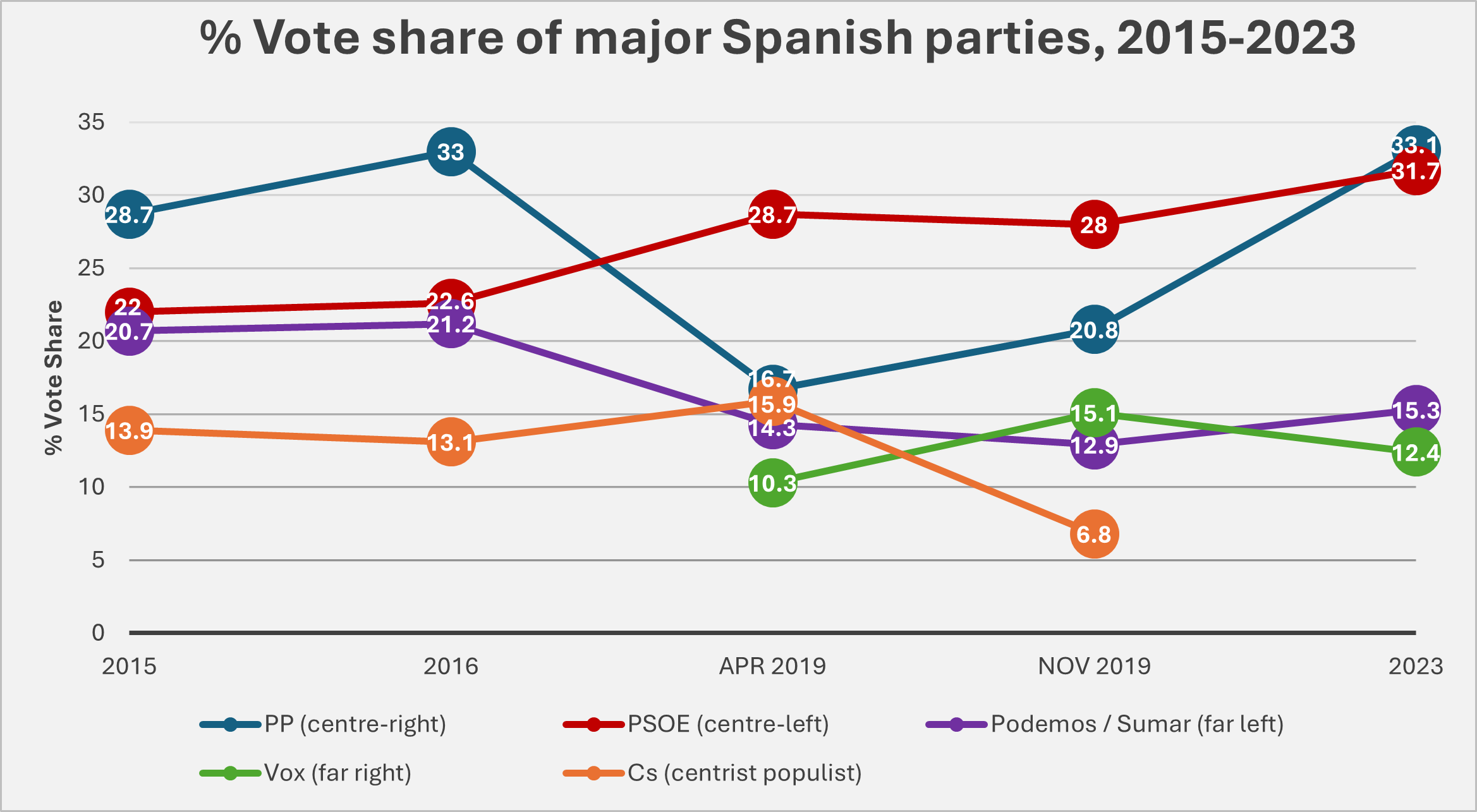
Percentage vote share of the major Spanish parties in general elections from 2015-2023.
Traditionally, in an electoral system such as Spain or the UK’s, this would be seen as a bad result. For decades (centuries, in the UK’s case), these countries have seen two major parties lock horns, each aiming for the roughly 40% of the vote required to secure a majority. Individual politicians could dream of being approved by 60% or even 83% of the population as José Luis Rodríguez Zapatero or Tony Blair respectively achieved. Now, in the UK, much like Spain, no single party is polling above 30% and none of the party leaders have a net positive approval rating.
A key question is whether you believe these results are due primarily to the failures of individual politicians (the popular view) or to broader political circumstances (the structural view)? Invariably, the answer is a mix of both, but Left on Read’s opinion is that the political fragmentation we are seeing is, at least in the medium-term, an inevitable consequence of the incredibly low levels of public trust in politics, as well as the fragmentation of information and credibility engendered by the internet.2 This is not a blip, then, but a pattern. Predictions often age poorly, but I would be shocked if any party secures 40% of the vote in a UK general election in the next decade.
In these circumstances, Sánchez’s approach suddenly starts to look quite attractive.
First, rather than playing the type of middle-of-the-road, consensus-seeking part required to win 40% of the vote and a net approval, Sánchez instead prefers to relentlessly target the 30% of the electorate who are actually inclined to vote PSOE. This is reflected in the (sometimes unpopular) stances he takes on the welfare state, foreign affairs, and cultural issues, which energise his base and antagonise opponents who were never likely to support him anyway.
Second, by seeking out divisive, ideological interventions, Sánchez is adept at creating ‘wedge issues’ that, much like Brexit, push opposition parties into difficult positioning choices. As a recent example, Sánchez’s attacks on Trump (who is deeply unpopular in Spain) have exposed divisions between Vox, who have effectively come out in full support of the Iran war, and the PP, who – much like the Tories – are caught in the difficult position of aping Vox to avoid leaking further votes to the right, or instead trying to court moderates.
Finally, Sánchez grasped early and wisely that Spain was entering an era of coalitions and electoral alliances. As such, his approach to elections and policies is attentive to the impact of his actions on the landscape of other political parties around him. His shift to the left partly reflects the reality that PSOE are dependent on the far-left for government formation, while after the April 2019 election he effectively allowed negotiations with Podemos to break down, gambling that after a follow-up election he could secure better terms in a future government. With the strong possibility that the next UK general election will result in left (Labour-Lib Dem-Greens) and right (Reform-Tories) blocs facing each other over a hung parliament, it remains to be seen whether UK politicians can as adeptly grasp this transition to pluri-party democracy.
Pedro Sánchez is far from the perfect politician. In recent years, he has been dogged by a series of corruption scandals surrounding members of his government, including allegations relating to the sale of Covid masks and sanctioned Venezuelan gold. He has also twice publicly considered resigning, and although he has now announced his attention to run again in 2027, it is quite possible he might not even still be leader in six months.
Regardless, Sánchez has survived as PM for eight years in a fiendishly complex political environment. During this time, he has delivered key policies that have a significant impact on Spain: from economic growth to green investment, enshrining abortion rights in the constitution, legalising half a million illegal migrants, banning social media for under-16s, and going some way to at least partly resolve the country’s Catalan independence crisis. All this he has achieved through courting his core vote, often seeking confrontation, and finding his way through crisis with ruthless political pragmatism and an unabashedly left-wing ideological tone.
In an era of highly divided, fractious politics, Left on Read suspects that the consensus-seeking model may soon be – if it is not already – dead and buried. For politicians who don’t wish to resort to full-blown populism, success is going to mean looking a lot less like Blair and Merkel and a lot more like Sánchez. Those on Europe’s left would do well to learn.
Yours, looking for a second-hand Peugeot,
LoR
This could be called ‘the Frederiksen method’ after Mette Frederiksen, the centrist Danish PM who has pursued strict immigration policies, now aped by Keir Starmer, in a so-far successful attempt to head off the far-right. Frederiksen and Starmer came together to state this perspective in a joint op-ed for the Guardian.
An interesting comparison is with post-Restoration England (1660-1689), where the explosion of print media greatly expanded the number of commentators and sources of information accessible to the (literate) public, reducing credibility and spawning numerous ‘print wars’. This was undoubtedly a contributing factor in the Exclusion Crisis (1679-81), during which fears of ‘Popish plots’ spread like wildfire. See Mark Knights, Representation and Misrepresentation in Later Stuart Britain (2005).