
#13 - The trouble with crime
Why both left and right are thinking about the ‘crimewave’ all wrong
If you believe what most people are telling you, crime in the UK – London in particular – is out of control.
Last summer, Nigel Farage launched his ‘Britain is lawless’ campaign, alleging in typically apocalyptic fashion that Britain’s streets are now ‘plagued’ by criminals and ‘droves of unvetted men’, leaving the UK ‘facing nothing short of societal collapse’. Judging by social media, this belief is widespread: the internet is awash with (sometimes admittedly very funny) memes portraying London as a video game simulation filled with slashing knives, while the number of likes on posts on X about London crime has increase more than ten times since 2023. These posts, which have a global appeal, are often closely linked to concerns about immigration and Islam (‘Londonistan’). It is little wonder then that, since 2014, the percentage of Britons viewing London as ‘unsafe’ has risen from 39% to 61%.
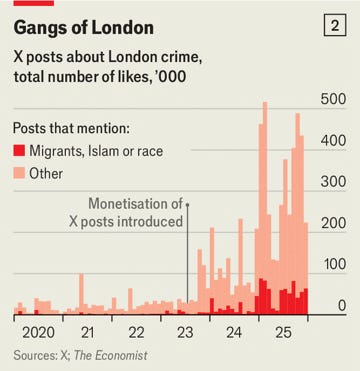
Total number of likes on X posts about London crime, 2020-2025. Source: The Economist.
Like a good liberal, Left on Read could spend a whole issue trotting out facts and stats to prove that the idea crime is rising is incorrect: the Crime Survey for England and Wales, which interviews 75,000 households annually about their experiences of crime, shows headline crime (including theft, violence and criminal damage) is at its lowest level on record; hospital admissions in London for assault by a sharp object, a good proxy for knife crime, are also at record lows; and the homicide rate in London is lower than Paris, Milan, Berlin, Toronto or pretty much any major US city.
But that would miss the point. The experience of crime, whether in the news or in person, is an emotional one – it is a trauma, in the sense of a lasting emotional breach, that is felt both individually and socially. And this latest wave of concern around crime is part of a coherent political narrative that like all narratives, takes this felt experience and magnifies it. This narrative emphasises feelings around control (‘unruly’ streets and ‘open’ borders), fairness (hard-working citizens and ‘lazy’ shoplifters), and contagion (London, the ex-Reform MP Rupert Lowe says, ‘increasingly resembles a third world country’).
To tackle the far-right, the left needs to address this narrative. To do so, Left on Read contends, we need to start thinking about crime in this broader social context – as a societal rift, a breakage, whether real or imagined – and treat it accordingly. In short, we need to stop thinking of this as a problem about crime and start thinking of it as a problem about justice.
To explain this idea, I am going to talk about Henry V.
This might seem odd: England’s second Lancastrian king (r. 1413-1422) is remembered today mostly as a conqueror, commemorated by Shakespeare (‘for Harry, England and St. George’), who vanquished the French nobility at Agincourt (1415) and nearly brought the Hundred Years’ War (1337-1453) to a victorious conclusion. To contemporaries, however, Henry was as much a ‘prince of justice’ who restored peace and order to England after decades of instability.1
In the fifteenth century, justice, like everything, began with God – eternally magnanimous, benevolent, and terrible. God gave stewardship of earth to kings, and as such they were beholden to govern their subjects in a godlike way. The king was head of the body politic, and if he embodied God’s justice, the other social orders (nobles, clergy, commoners) would soon follow suit.
I, John Gower, conclude my counsel: the king and his people are like the head and the body. Where the head is infirm the body is infirm. Where a virtuous king does not rule, the people are unsound and lack good morals. (John Gower, c. 1400)
When Henry took the throne in 1413, this balance had been severely upset. His father, Henry IV (r. 1399-1413), had illegally seized power from Richard II (r. 1377-1399), a temporarily stabilising but fundamentally unsettling breach of the political order that was justified on the basis of Richard’s moral failings. To prop up his questionably legitimate regime, Henry IV leant heavily on his Lancastrian retinue – essentially an armed posse of paid supporters who provided useful muscle yet riled locals with lawbreaking that largely went unpunished. To compound matters, Henry IV faced Owain Glyndŵr’s long and remarkably successful Welsh rebellion (1400-c.1415) and the problem of the Lollards, a loosely-defined group of anti-clerical religious nonconformists. The kingdom was thus in disorder at every level: in matters of religion, kingship, and social peace.
Do law away, what is a king?
Where is the right of any thing
If there be no law in the land? (John Gower)
Henry V quickly grasped the centrality of this problem. It goes without saying, however, that he didn’t use any ‘crime survey’ to restore order. Instead, he focused on the visible and restorative aspects of justice, making use of the tremendous authority associated with the king’s person himself.
In 1414, Henry ordered the court of the king’s bench to accompany parliament to the Midlands, where disorder had been the most pronounced. With Henry’s oversight, the court reviewed local criminal administration and received and processed thousands of indictments. On one occasion, Henry personally diffused a quarrel between two knights by demanding that unless they made peace ‘by the time he had eaten his oysters’, they would be hanged. At this case suggests, Henry was willing to use exemplary violence – forty-five Lollard rebels were executed on one day in 1414 – but his main focus was on reconciliation. Later that year he issued a general pardon, by which 5,000 people were forgiven crimes including treason, murder and rape in exchange for a fine of sixteen shillings and four-pence.
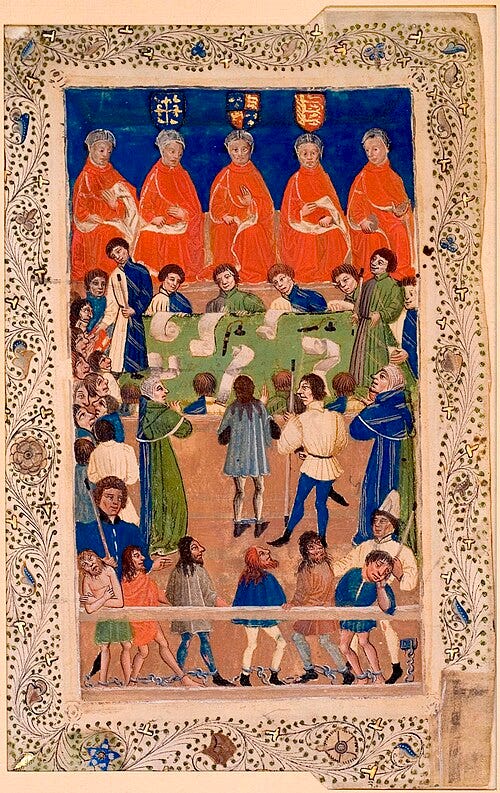
The Court of the King’s Bench, depicted c. 1460.
#/media/File:Court_of_King's_Bench.JPG)
As the historian Edward Powell noted, ‘if Henry V was seeking primarily to punish crime… his plans undoubtedly failed’. But that was not his aim: instead, Henry set about reconciling warring parties and restoring social order. In that, he undoubtedly achieved a great success: despite spending most of his remaining years at war in France, he faced no serious domestic unrest again in his reign.
Naturally, in the twenty-first century we see justice in a rather different way, Yet the idea of a sickness in the body politic is as potent as ever: and when it is felt that wrongs go unchecked, and wrongdoers don’t get their just deserts, morale is sapped, despair increased, and radical remedies encouraged.
Henry correctly recognised that justice is about ‘making things right’ and ‘restoring peace’; he understood that it is something physically seen and felt, and so he brought it to his subjects. Henry couldn’t dream of possessing the coercive apparatus – police, CCTV, prisons, courts – of a modern state, but as such he could not be lulled into the modern deception that justice solely entails the catching of every culprit, and the application of every correct sentence.
There are two ways of applying this thesis to contemporary politics. The first is, as Left on Read has previously urged, for politics to take a much stronger interest in the wider social issues – inequality, loneliness, internet culture, lack of social community – that fuel perceptions of injustice. It is particularly notable in this regard that ‘anti-social behaviour’ – a behaviour that is not in fact a crime, and so had to be made into one – ranks as the number one type of ‘crime’ that people are concerned about locally. If people are more bonded with their neighbours and their compatriots, they are less likely to regard them suspiciously.
The second aspect concerns the justice system itself. From 2010, the Coalition and later Conservative governments made a decision, which at first seems not unreasonable, to comparatively protect policing (and therefore safety) at the cost of justice. Thus, while policing saw a real terms spending cut of a maximum of 17%, spending on the courts and Crown Prosecution Service fell more quickly and deeply, by 23% and 28% respectively.
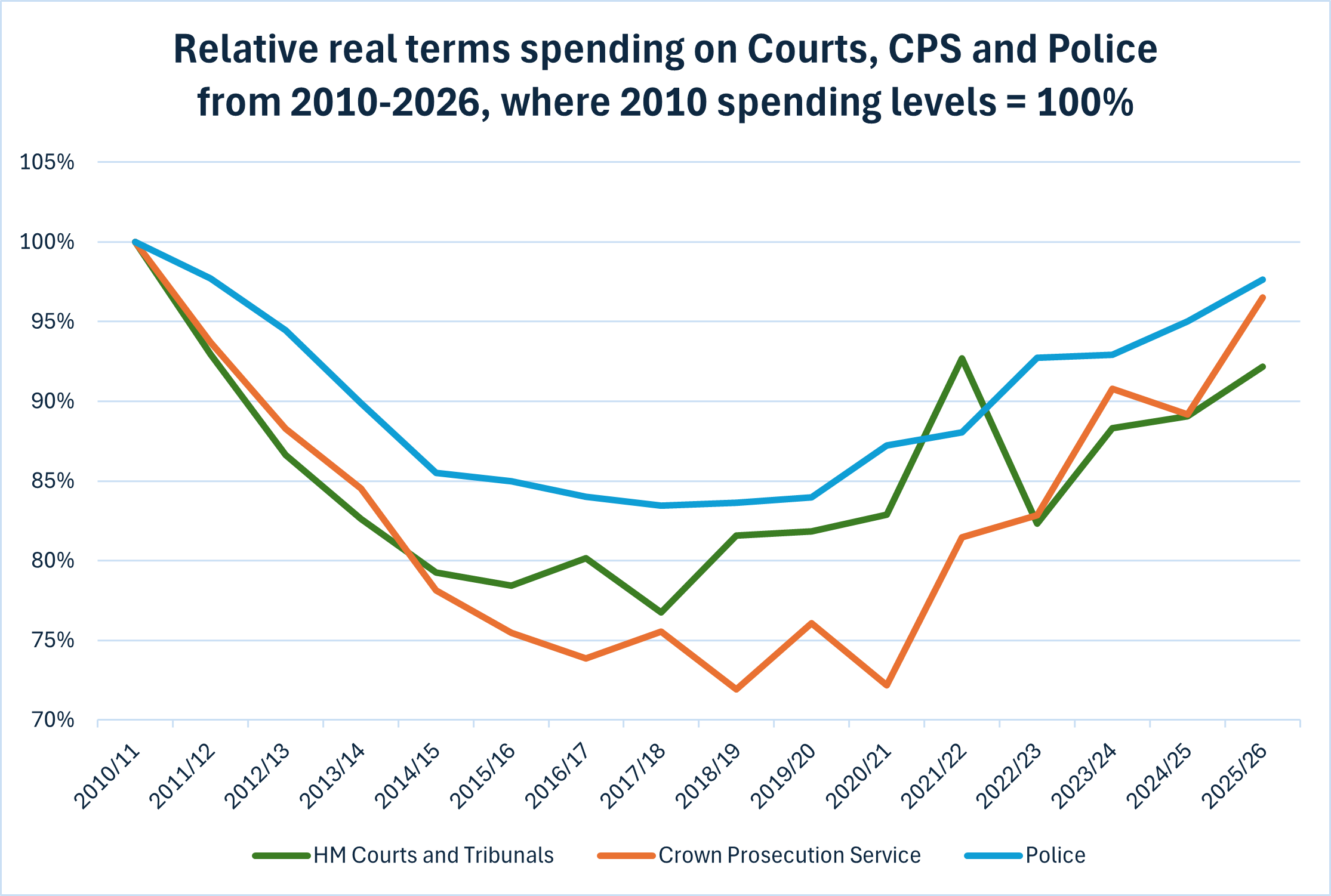
Relative real terms spending on HM Courts and Tribunals, the Crown Prosecution Service, and Police from 2010-2026, where 2010/11 spending levels = 100%. Source: Institute for Government (1 and 2).
The consequent degradation of the justice system (though this is not solely the result of cuts) is by now well-known: since Covid, the backlog of outstanding cases in magistrates’ courts (which hear less serious offences) has increased from around 220,000 to 360,000, and in the crown courts from around 40,000 to 80,000. Those who plead ‘not guilty’ in a crown court have to wait on average nearly eleven months for a first hearing, while 26% of all cases spend more than a year in the backlog. While the number of police officers has now recovered pre-recession levels, there are 45% fewer magistrates, and 29% fewer permanent court staff overall.
This relative prioritisation reflects a decision that the absolute level of crime is more important than how it is resolved. Concordantly, much concern about the court backlog focuses on the number of untried criminals now wandering the streets – rather than on the experience of justice (including for those numerous suspects locked up on remand before trial). In reality, these long waits are highly distressing for both victims and those accused, and often discourage people from making use of the justice system at all, while the expected resolution has less of a restoring impact when it is so far from the event itself. Proposed ‘fixes’ – such as the ‘single justice procedure’ (whereby 65% of magistrates’ cases are now decided solely based on written submissions, often in less than a minute) and a proposed reduction in jury trials – may help by improving waiting times, but only worsen the experiences of those going through the courts.
Thus, while the public is now less likely to experience crime, it is also less likely to experience justice. This is critical because – as with health services – our experience of crime is not just about the problem itself, but how it is responded to: from the police investigation, to whether a suspect is identified and charged (an outcome that now results in only 7.3% of cases), to any experience in court. What matters is not only the breach, but how it is healed.2 And although in an average year most of us don’t experience crime or the justice system, we all know people who do.
Tackling these problems is certainly not easy. What Left on Read is suggesting, however, is a different way of looking at the problem: seeing justice as Henry V would have understood it, as a matter of restoring social peace, rather than simply punishing crime. We can make people safer and safer, but without dealing with breaches where they occur, people won’t feel trust and security – and most likely, support for the far-right will grow.
For politicians, particularly those on the technocratically-minded centre-left, this is an instructive point. Politicians and policy-makers are not one and the same: a policy-maker, broadly speaking, must concern themselves with objective data – their aim is to reduce crime or cut waiting lists, to enact a politician’s vision; a politician, however, must play a mediating role between facts and feelings: like Henry, they must grasp the ability of politics to connect objective realities with social trends.
A politician’s concern is therefore not just the safety, the objective wellbeing, of their citizens, but the social health of the wider political community. Their success should be judged not only by ONS stats, but by how the public thinks and feels. And, as John Gower warned Henry IV, politicians should be mindful of their own example: to restore the impression of justice, they must begin with how they practise politics themselves.
Yours, finishing my dish of oysters,
LoR
This section is based primarily on chapters by G. L. Harriss, ‘The Exemplar of Kingship’, and Edward Powell, ‘The Restoration of Law and Order’, in Harriss’ edited collection, Henry V: The Practice of Kingship (1985).
To be clear, prison sentences are far from the only way of healing breaches – nor are they often the most desirable. An argument based on the social impact of crime only strengthens the case for rehabilitation.